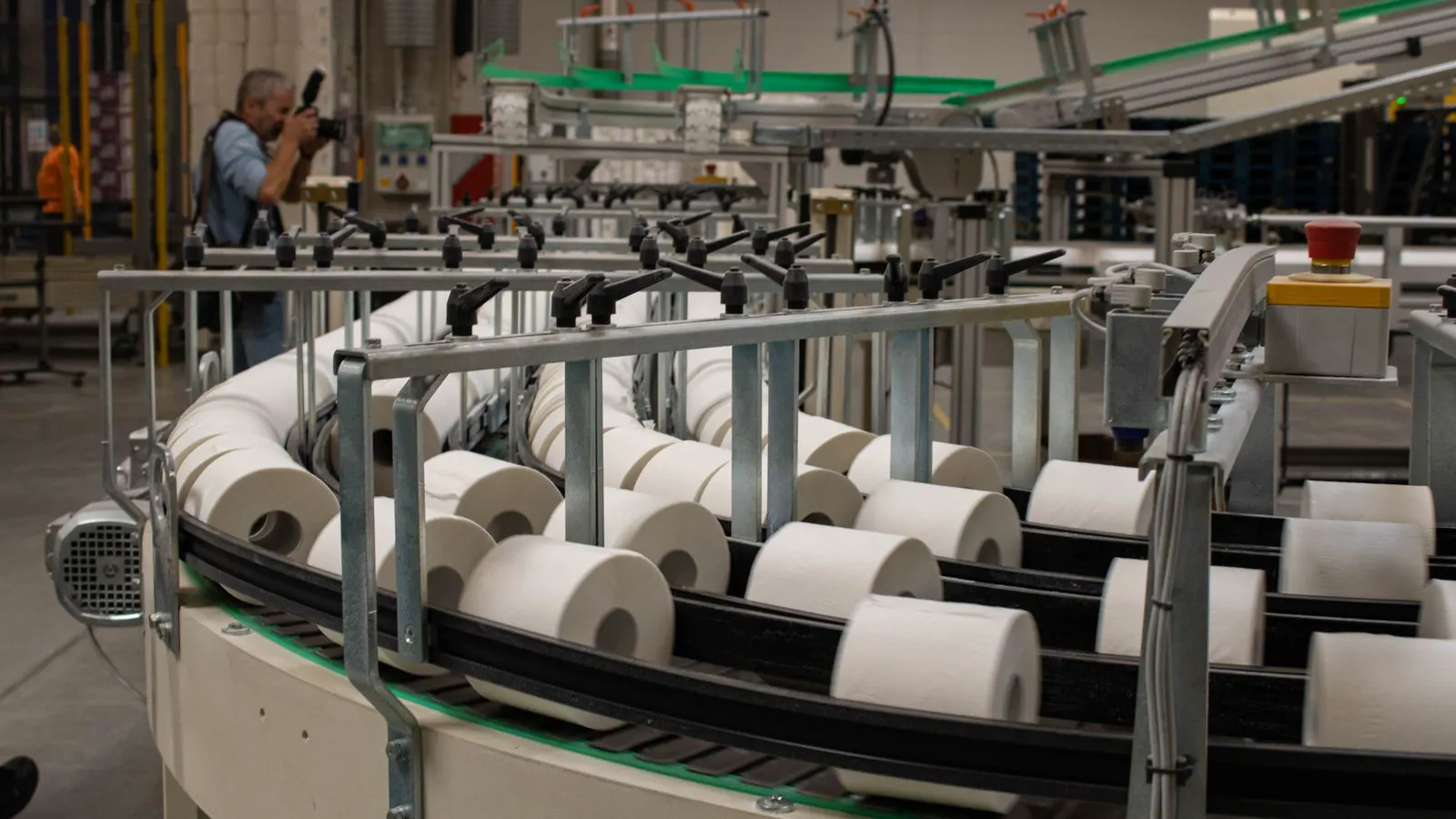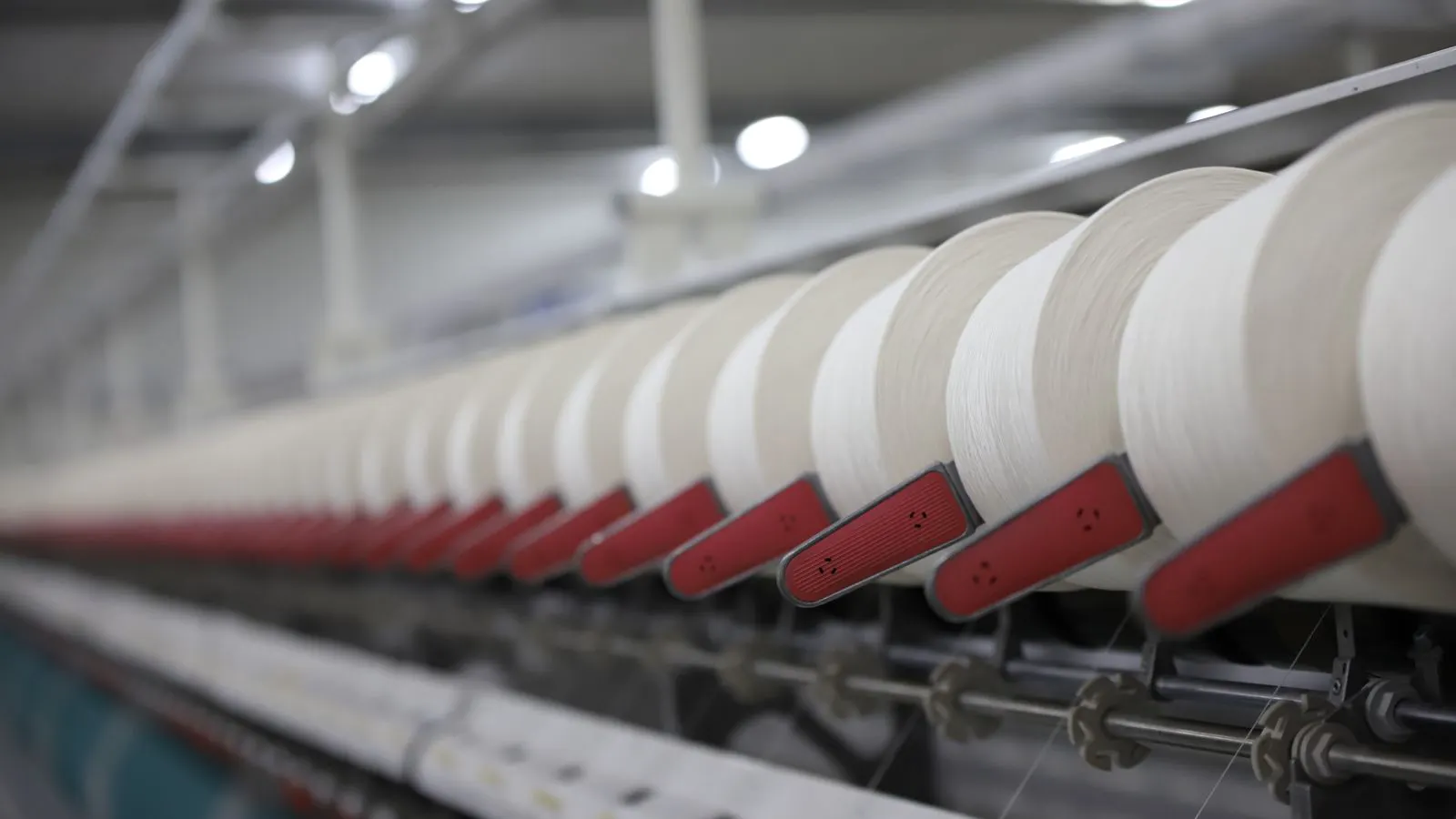
Meltblown fabric forms when polymer pellets are melted, blown through a die into fine filaments, and collected on a web. The resulting fiber diameter, weight, and bond strength depend on melt temperature, air velocity, and collection speed. Engineers use these process variables to match fabric performance and consistency.
- Meltblown fiber structure depends on melt temperature, air velocity, and collection speed.
- Lower collection speeds typically yield heavier, more open webs with longer fibers.
- Filament weight and fiber diameter are the primary checks for sourcing meltblown fabric.
- Bonding method affects liquid resistance, filtration, and durability.
- Process stability matters as much as nominal specs when evaluating suppliers.
How the Meltblown Process Creates a Web
Meltblown fabric starts as polymer pellets, most often polypropylene. A hopper feeds the pellets into a heating unit, and the material becomes a uniform melt. The melt passes through a die with many small orifices. High-pressure air blows the molten streams into the air stream, where they solidify into fine filaments.
A suction fan draws the fiber stream toward a moving belt or wire mesh. The fibers land randomly and overlap. The result is a continuous web. Unlike spunbond, where a continuous thread is laid down, meltblown fiber consists of thousands of individual filaments that are much thinner and less uniform.
This difference shapes every downstream property. The fiber is thin enough to trap small particles. The web is open enough to allow airflow. The random layout gives the fabric a soft, nonwoven character. For engineers, these traits define the application boundary. Meltblown fabric is used in filtration, medical barrier materials, insulation, and hybrid laminates. It is not typically used for structural or load-bearing applications.
What Determines Fiber Diameter and Weight
The physical size of each filament is set by the ratio of melt volume to air velocity. If the air stream is fast and the melt volume per orifice is small, the fiber becomes very thin. If the melt volume is higher or the air velocity is lower, the fiber becomes thicker.
Fiber diameter is usually measured in micrometers. In practice, a single fiber is too small to inspect visually. Quality control relies on weight per unit area, or areal weight. A meltblown web of a given areal weight can be made with different fiber diameters and different fiber lengths. A heavy web can be made from very fine fibers or from slightly thicker fibers with more overlap.
Areal weight is the most common specification in sourcing documents. It is expressed in grams per square meter. For a given areal weight, the fiber structure changes when the process is adjusted. A web made at a slower collection speed has longer fibers and more overlap. A web made at a faster speed has shorter fibers and less overlap. The areal weight may stay the same, but the feel, liquid resistance, and filtration behavior change.
Engineers should ask suppliers for fiber diameter distribution or at least for a process description. A nominal areal weight alone does not tell you how the web was built. Two suppliers can both deliver the same areal weight, yet produce very different performance if the fiber diameter or fiber length differs.
How Collection Speed Shapes Fiber Layout
Collection speed is one of the strongest levers in meltblown production. It is the speed of the moving belt or wire mesh below the die. When the belt is slow, the fibers have more time to be deposited. The fiber stream spreads out over a longer path. The fibers land in a more relaxed state. The web becomes heavier for the same areal weight target, or the same areal weight can be achieved with a lower melt rate.
When the belt is fast, the fibers are carried down the web quickly. The fiber stream is stretched. The fibers land in a more linear, directional state. The web becomes lighter for the same areal weight target, or the same areal weight requires a higher melt rate.
The effect on structure is significant. A slow-collection web tends to have more fiber overlap and a more open, fluffy structure. It may feel softer. It may have lower liquid resistance because the fiber diameter is often finer. A fast-collection web tends to have a tighter, more directional structure. It may feel stiffer. It may have higher liquid resistance because the fiber diameter is often coarser.
These differences matter for sourcing. If an application requires high liquid resistance, a fast-collection, coarser-fiber meltblown may be a better fit than a slow-collection, finer-fiber meltblown of the same areal weight. If an application requires high particle filtration, a slower-collection web with finer fibers may perform better. The areal weight is the same. The structure is not.
Bonding and the Final Web
Meltblown fibers are often produced without a chemical bonding agent. The fibers contact each other in the web and form a bonded network through mechanical entanglement and thermal fusion. This is sometimes called self-bonding. The fibers are hot when they land. As they cool, they may fuse at contact points. The result is a web that holds together without adhesives.
Some meltblown webs are bonded with a mechanical calender or a thermal press. This compresses the web and increases fiber-to-fiber contact. It improves dimensional stability and reduces fiber migration. It can also increase liquid resistance by reducing the effective pore size.
For filtration applications, the bond strength is less important than the fiber structure and the pore size distribution. For barrier applications, bond strength and dimensional stability matter more. For insulation applications, the open structure is a feature, not a defect.
When sourcing meltblown fabric, ask how the web is bonded. A self-bonded web may behave differently from a mechanically bonded web of the same areal weight. The bond method affects how the fabric performs under heat, moisture, and mechanical stress.
Sourcing Checks That Reveal Process Quality
A supplier may list areal weight and fiber material. That is a start. It is not enough. The process quality is visible in consistency. A stable meltblown process produces a web with uniform areal weight across the width of the roll. A web with high variation in areal weight across the width suggests unstable melt flow or inconsistent orifice output.
Check for cross-web variation. Roll a sample across the width. Weigh a set of small squares. If the variation is large, the process is not stable. A stable process is a better predictor of performance than a nominal spec sheet.
Check for fiber migration. After a short storage period, examine the surface. If fibers migrate to the surface, the web is not stable. Fiber migration can reduce filtration performance and create a weak surface. It also makes the fabric feel less uniform.
Check for liquid resistance. A meltblown web with a fine fiber structure will have low liquid resistance. A web with a coarser fiber structure will have higher liquid resistance. If the application requires liquid resistance, a simple areal weight spec is not enough. Ask for the fiber diameter distribution or the liquid resistance method.
Check for dimensional stability. Meltblown webs can shrink or relax after production. If the fabric is used in a dimensionally sensitive assembly, ask about relaxation behavior. A web that shrinks after heat treatment may not fit a tight tolerance.
Worked Example in Plain Words
An engineer needs a meltblown fabric for a medical barrier laminate. The target areal weight is 20 grams per square meter. The application requires high liquid resistance and low particle transmission. The engineer asks two suppliers for samples.
Supplier A delivers a 20 gram per square meter web that was produced at a slow collection speed. The fiber diameter is fine. The web is fluffy. The liquid resistance is low. The particle filtration is excellent. The web is soft and easy to laminate.
Supplier B delivers a 20 gram per square meter web that was produced at a fast collection speed. The fiber diameter is coarser. The web is stiffer. The liquid resistance is higher. The particle filtration is good but not as fine as Supplier A. The web is easier to handle in a laminator.
Both samples meet the areal weight spec. Neither meets the application spec without adjustment. The engineer chooses Supplier B for the barrier layer and adds a spunbond layer for structural strength. The final laminate combines the liquid resistance of the fast-collection meltblown with the strength of the spunbond.
This example shows why areal weight alone is not enough. The process variables that create the fiber structure are what determine whether the fabric fits the application. The same number on the spec sheet can mean two different materials.
Practical Implications for Buyers
When sourcing meltblown fabric, start with the application requirement. Define the performance need. Liquid resistance, particle filtration, feel, dimensional stability, and bond strength are all driven by the fiber structure. The fiber structure is driven by the process.
Ask the supplier for process information. A reliable supplier can describe the die, the collection speed, the bond method, and the quality control checks. A supplier that only lists areal weight and material may not be able to support the application.
Request samples before committing. Test the samples against the actual application conditions. A web that performs well in a lab may not perform well in the field. The field conditions may include heat, moisture, mechanical stress, or chemical exposure.
Keep a sample record. Store samples from different batches and different suppliers. Compare them over time. Process drift can change the fiber structure even when the areal weight stays the same. A sample record gives you a baseline for comparison.
Meltblown fabric is a process product. The spec sheet is a summary. The process is the source. Understand the process, and the spec sheet becomes a useful tool. Ignore the process, and the spec sheet becomes a misleading number.
Frequently asked questions
What is the main difference between meltblown and spunbond fiber structure?
Meltblown fiber consists of fine, individual filaments that are blown and collected randomly. Spunbond fiber consists of continuous threads that are laid down in straight lines. The fiber diameter and layout are very different.
How does collection speed affect meltblown fabric?
Collection speed controls fiber length and fiber overlap. A slower speed produces longer fibers and more overlap. A faster speed produces shorter fibers and less overlap. The areal weight can be the same, but the structure changes.
What is the most important spec for meltblown fabric?
Areal weight is the most common spec, but it is not enough on its own. Fiber diameter distribution, bond method, and liquid resistance are also important. The process variables that create the structure matter as much as the nominal weight.
Can meltblown fabric be used for structural applications?
Meltblown fabric is not typically used for structural or load-bearing applications. It is used for filtration, barrier, insulation, and hybrid laminates. For structural strength, a spunbond layer or a different material is usually added.
How do I verify process quality from a supplier?
Ask for process information and request samples. Check for cross-web variation, fiber migration, and dimensional stability. A stable process is a better predictor of performance than a nominal spec sheet.